
Why Are Mailer Boxes So Expensive?
Introduction
In today’s fast‑growing e‑commerce industry, packaging is no longer just a way to ship products—it has become a key brand touchpoint. Among the most popular solutions are mailer boxes.
However, in recent years, many retailers and small business owners have noticed a worrying trend: the cost of mailer boxes has been steadily rising. Materials, production, customization, and logistics have all contributed to the surge in pricing. This has a direct impact on profit margins, particularly for startups and independent brands that rely on cost‑effective packaging solutions to remain competitive.
So why are mailer boxes so expensive? And more importantly, how can businesses continue using them without overspending?
This article explores the key reasons behind rising mailer box costs—from raw material shortages to the growth in online shopping—while also providing practical tips for reducing expenses, exploring alternatives, and making smarter packaging investments. By the end, you’ll have a clear roadmap for balancing quality, branding, and budget with the help of expert suppliers like Meiyin Packaging.
Why Mailer Box Matter
At Meiyin Packaging, we specialize in multiple variations of mailer boxes, such as custom corrugated mailer boxes, tuck boxes, and even collapsible magnetic boxes, depending on whether a business needs lightweight shipping or luxurious unboxing. Each option can be tailored in size, color, and finish to align with a brand’s identity.
Mailer boxes matter because they serve two critical purposes:
- Product Protection – Their corrugated board layers provide cushioning and resistance to pressure, which minimizes damage during shipping. For delicate products like cosmetics (cosmetic packaging options) or chocolates (custom chocolate boxes), this function is invaluable.
- Brand Experience – Beyond functionality, mailer boxes act as a marketing tool. A thoughtfully designed mailer box—perhaps paired with custom thank you cards or stickers & labels—creates a memorable unboxing moment that encourages word‑of‑mouth and repeat purchases.
This dual role makes mailer boxes indispensable for both e‑commerce and subscription models. They aren’t just containers; they actively strengthen branding, build customer trust, and influence buying decisions.
Key Reasons Why Mailer Boxes Are Expensive
Rising Raw Material Costs
The primary material for mailer boxes is corrugated fiberboard , which is made from paper pulp. Over the last few years, global pulp and paper costs have surged due to limited forestry resources, environmental regulations, and increasing transportation fees. For premium packaging needs—like luxury magnetic gift boxes (wholesale options)—the thicker and more durable the paperboard, the higher the cost.
Production and Manufacturing Costs
Unlike plain cartons, custom mailer boxes require advanced printing, die‑cutting, and folding processes. Multi‑color CMYK printing, lamination, embossing, or foiling all add to the expense. For instance, if a brand wants custom drawer box packaging with inserts or multiple layers, the complexity increases labor and machinery usage. Rising energy costs and skilled labor further push prices up.
Supply Chain Disruptions
Global events—such as the COVID‑19 pandemic, port delays, or geopolitical conflicts—have caused massive disruptions in material supply and shipping logistics. Businesses relying on imported raw paper and specialty coatings often face higher costs. Even add‑ons like custom paper bags or paper display boxes are affected when the global supply chain faces stress.
High Demand from E‑Commerce Growth
With explosive growth in global online shopping, demand for mailer boxes has skyrocketed. Subscription box services in beauty, fashion, and food all favor branded packaging for differentiation. This surge strains suppliers’ capacity, leading to higher per‑unit costs. Products like custom apparel boxes and two‑piece boxes often compete with mailer box production for material allocation.
Transportation Costs
Rising global fuel prices and logistics fees directly inflate packaging costs. For larger mailer boxes, shipping carriers calculate by dimensional weight, meaning brands pay more for bulky but lightweight boxes. This especially affects businesses fulfilling international orders or shipping bulky cosmetics, jewelry, or electronics in rigid tube boxes.
Customization and Branding Add‑Ons
Today’s customers expect more than a plain brown box. Unique finishes like embossing, gold foiling, custom inserts, or inner printing increase appeal—but they also add cost.
How Rising Costs Impact Businesses
Rising packaging costs affect companies in very different ways depending on their size and business model.
Small E‑Commerce Brands
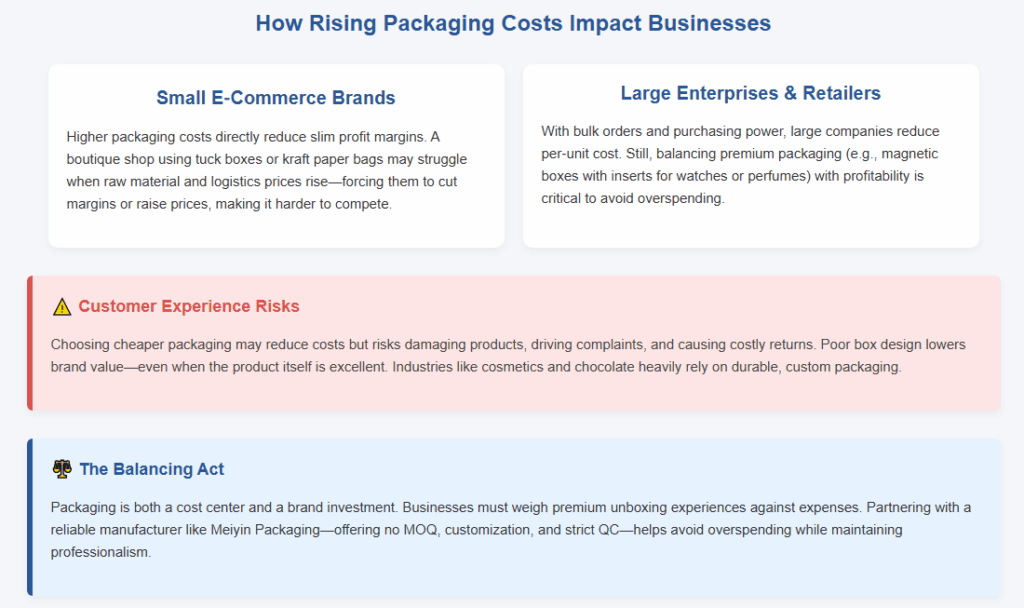
For startups and small online shops, higher mailer box expenses directly reduce already slim profit margins. A boutique brand selling handmade soaps or candles might depend on cost‑effective tuck boxes or kraft paper bags. But when raw material and logistics prices spike, they often have to either cut into margins or pass costs onto customers. This makes it harder to stay competitive.
Large Enterprises and Retailers
Bigger companies have more purchasing power and can reduce per‑unit costs by ordering in bulk. Still, balancing quality versus expense remains crucial. For example, premium retailers may choose luxury magnetic boxes with inserts for high‑end items like watches or perfume. While impressive, overspending on packaging can eat away at profits if not managed carefully.
Customer Experience Risks
On the flip side, choosing cheaper packaging solutions carries its own risks. Inadequate protection easily leads to damaged goods, customer complaints, and costly returns. A poorly designed box diminishes brand value, no matter how beautiful the product inside. That’s why industries such as cosmetics (cosmetic packaging boxes) and chocolates (custom chocolate gift boxes) heavily rely on durable, customized paper packaging.
The Balancing Act
Ultimately, businesses need to strike a middle ground. Packaging is both a cost center and a brand investment. Companies must evaluate whether a premium unboxing experience truly boosts sales and customer loyalty enough to justify the higher expenses. Partnering with reliable manufacturers like Meiyin Packaging—who offer no MOQ, flexible customization, and strict quality control—can help brands prevent overspending while maintaining professional packaging.
Practical Ways to Reduce Mailer Box Costs
While mailer boxes are undeniably valuable, there are several smart strategies businesses can adopt to control expenses without sacrificing quality.
Order in Bulk or Plan Ahead
Purchasing in larger quantities reduces per‑unit costs and ensures stable supply, particularly during high‑demand seasons. Instead of last‑minute smaller orders, consider bulk purchasing for core packaging needs like corrugated mailer boxes or two‑piece boxes.
Simplify Customization
While embossing, foiling, and specialty coatings are attractive, they add substantial cost. Brands can achieve an elegant look with simpler options such as custom stickers and labels or paper hang tags instead of intricate print designs. Minimalist packaging is also aligned with sustainable packaging trends .
Optimize Size and Structure
Oversized boxes not only waste material but also increase shipping costs (due to dimensional weight). Using appropriately sized packaging, such as paper tube boxes for small items or drawer boxes for luxury goods, ensures maximum efficiency.
Combine Packaging with Marketing Materials
Instead of spending heavily on multiple branded elements, integrate marketing tools directly into your packaging. For example, slip a thank you card or printed brochure inside the box. This enhances customer experience while maintaining budget control.
Choose a Reliable Supplier
Partnering with a trusted, one‑stop factory like Meiyin Packaging helps achieve consistent quality, competitive wholesale prices, and faster turnaround. Long‑term partnerships often lead to better rates, flexible MOQs, and strong after‑sales support.
Alternatives to Mailer Boxes (Budget Solutions)
For businesses struggling with rising mailer box costs, there are practical and budget‑friendly packaging alternatives that can still protect products and deliver a satisfying unboxing experience.
Poly Mailers & Padded Envelopes
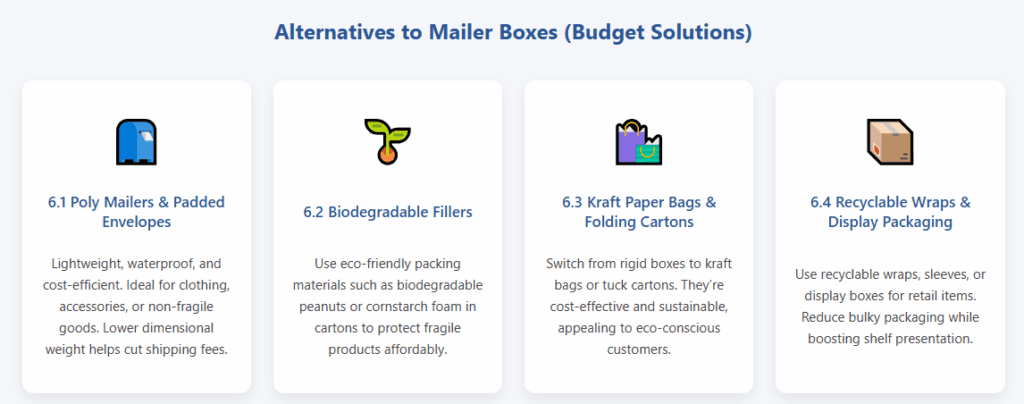
Poly mailers and padded envelopes are lightweight, waterproof, and cost‑efficient. They work best for soft items such as clothing, accessories, or non‑fragile goods. Compared with rigid boxes, they reduce shipping fees thanks to lower dimensional weight.
Biodegradable Fillers & Foam Substitutes
Instead of relying solely on corrugated mailer boxes, companies can ship products in simpler cartons while using eco‑friendly protective fillers such as biodegradable packing peanuts or cornstarch foam. These materials protect fragile items without adding much cost.
Kraft Paper Bags & Folding Cartons
Another strong option is switching from heavy rigid boxes to kraft paper bags (custom paper bag solutions) or folding cartons like tuck boxes. They’re not only cost‑effective but also eco‑friendly, making them attractive for customers who value sustainable packaging.
Recyclable Paper Wraps & Display Packaging
For small or non‑fragile items, recyclable wraps or sleeves made from kraft or art paper can replace bulky mailer boxes. Retail products can also benefit from paper display boxes, which double as functional packaging and attractive point‑of‑sale presentation.
By exploring these alternative solutions, brands can balance cost control with environmental responsibility, while keeping the packaging aligned with their branding values.
Future Trends: Will Mailer Boxes Get Cheaper or More Expensive?
Looking ahead, the future of mailer box pricing will likely depend on technology, sustainability, and supply chains. Here are a few key trends:
Digital Printing & Short‑Run Customization
Advances in digital printing make it easier for brands to order short‑run packaging with personalized designs, seasonal themes, or influencer collaborations. While this flexibility favors small businesses and subscription models, it usually increases per‑unit costs compared to large‑volume offset printing. Solutions like custom booklets or brochures can also be integrated into packaging for storytelling, but add to the expense.
Stricter Sustainability Regulations
As governments worldwide impose stronger sustainable packaging policies, brands will need to transition to recyclable materials such as kraft, corrugated, or biodegradable coatings. Demand for eco‑packaging—like kraft paper hang tags or paper tube boxes—is set to grow, but these greener solutions often carry higher costs due to limited supply and stricter compliance requirements.
Supply Chain Recovery & New Materials
On the positive side, gradual supply chain recovery combined with emerging sustainable material technologies (like mushroom packaging or recycled fibers) may help stabilize raw material pricing. Manufacturers such as Meiyin Packaging are already exploring diverse structures—ranging from drawer boxes to two‑piece boxes—that can balance luxury branding with efficiency.
Smart Packaging: QR Codes & NFC
Another rising trend is smart packaging, where boxes feature QR codes, NFC chips, or AR triggers. These interactive elements enhance customer engagement and brand storytelling but increase printing and integration costs. Packaging paired with thank you cards or digital loyalty programs could further bridge the offline‑online gap.
In short, while some innovations may push prices up, others—like better logistics and new eco‑materials—could make mailer boxes more cost‑balanced in the long run.
Conclusion
The rising price of mailer boxes is driven by a combination of factors—raw material costs, complex customization, global supply chain fluctuations, and increasing demand from the booming e‑commerce sector. While these expenses can create challenges for businesses, they also represent added value: stronger product protection, eco‑friendly solutions, and enhanced branding through memorable unboxing experiences.
Rather than cutting corners, companies should focus on balancing cost with quality. Partnering with an experienced supplier like Meiyin Packaging—with over 19 years of expertise, advanced printing services, eco‑friendly materials, and flexible MOQ—ensures you get packaging that protects products, pleases customers, and communicates brand identity.
Whether you need corrugated mailer boxes, magnetic boxes, drawer gift boxes, or eco‑friendly paper bags, Meiyin offers a one‑stop packaging solution.
 Ready to reduce packaging stress while elevating your brand? Visit our Products catalog or Contact Us today to start your custom order.
FAQ Section
Q1: Why are mailer boxes more expensive than standard shipping boxes?
Mailer boxes are made from high‑quality corrugated cardboard, often featuring custom printing and coatings. Unlike plain cartons, they provide both structural protection and branding, which adds to the cost. (Learn more about corrugated fiberboard)
Q2: Do custom designs make mailer boxes costly?
Yes. Special finishes like embossing, gold foiling, or inner printing increase production complexity and raise unit costs. Choosing simpler branding tools such as stickers and labels can help keep budgets under control.
Q3: How can small businesses save money on mailer packaging?
Startups can lower costs by:
- Ordering in bulk
- Choosing folding tuck boxes instead of rigid boxes
- Using cost‑effective branding add‑ons like thank you cards instead of intricate finishes
Q4: Are eco‑friendly mailer boxes always pricier?
Eco‑materials like kraft or biodegradable coatings generally cost more due to limited supply. However, sustainable packaging aligns with consumer values and can boost long‑term brand loyalty.
Q5: What are the cheapest alternatives for e‑commerce shipping?
Budget options include poly mailers, padded envelopes, kraft paper bags, or paper display boxes. These are light, recyclable, and significantly cut shipping fees.

Hi, I'm WiWi Deng, hope you like this blog post
With more than 10 years of experience in OEM/ODM/Private Label Paper Packaging, I'd love to share with you the valuable knowledge related to paper box products from a reliable Chinese supplier's perspective.
Contents
Own your OEM/ODM/Private label of paper packaging is so easy here.