
Tuck Boxes vs. Rigid Boxes: The Ultimate Professional Selection Guide
Many brands face a common dilemma in product packaging: more economical tuck-end boxes or premium rigid boxes?
Basically, the former helps you save on costs and gives you more room to play with designs, whereas the latter is all about that quality feel that elevates the brand. When you need to weigh brand image against packaging costs, how should you choose?
To help you make the right choice for your brand, this article breaks down the key differences between them, looking at everything from their structure and durability to cost, shipping, and ideal uses.
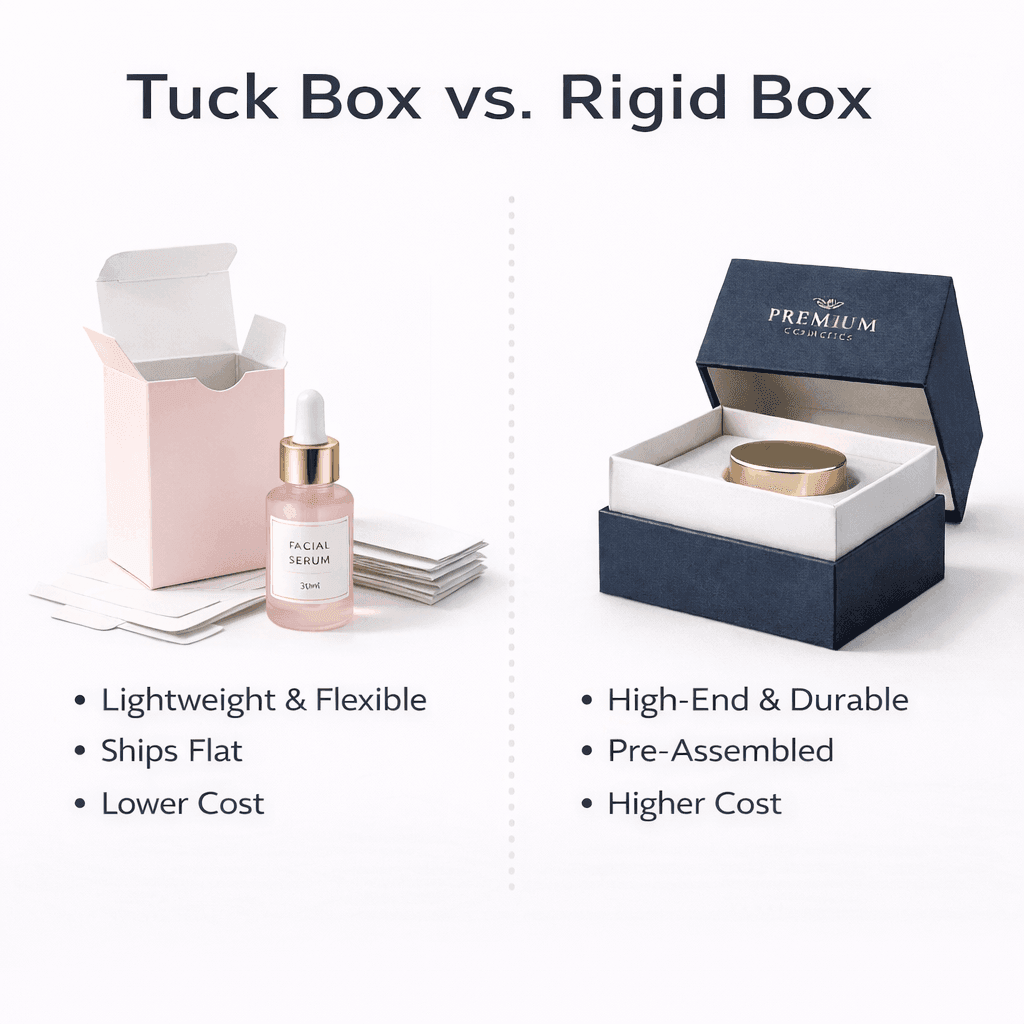
What Is a Tuck Box in Packaging?
A tuck-end box is basically a paperboard carton where the top and bottom flaps are designed to fold and tuck right back into the box itself to keep it closed.
Common types include:
- Straight tuck end boxes
- Reverse tuck end boxes
- Tuck top cardboard boxes
- Auto bottom tuck box
The boxes are composed of lightweight paperboard. Additionally, they are shipped flat. This combination of factors makes them a cost-effective choice for wholesale buyers.
The main characteristics of the Tuck Packaging Boxes are:
- Shipped flat (freight cost is less)
- Easy to assemble
- Custom printable surface
- Lightweight yet functional
- Fit well on retail shelves
What Is a Rigid Box in Packaging?
Rigid boxes (set-up boxes) are produced out of thick chipboard and coated in printed or textured paper.
They are already assembled and are not folded flat.
Typical uses include:
- Luxury cosmetics
- Jewelry packaging
- Premium electronics
- Gift boxes
Rigid boxes give you that high-end look and feel, and they stay that wayno bending or collapsing over time.
Tuck Box vs Rigid Box: Detailed Comparison
How do they stack up? Let’s go through cost, shipping, durability, and brand image.
Cost Comparison
This is where the biggest difference lies.
Tuck boxes are made from printed paperboard that serves as both structure and printable surface. The paper weight is generally medium, typically 250gsm-400gsm. Most Chinese factories use highly automated production lines for tuck boxes. In China, for large orders, the price per unit is generally below USD 0.5.
Rigid boxes use cardboard for structural strength and lamination paper for the printing surface. The cardboard is typically 800gsm-1200gsm, and the printed paper is 120-150gsm. Sometimes the wrapping paper is laminated on the cardboard surface manually. In China, the cost of a rigid box is no less than USD 1.
Feature | Rigid Box | Tuck Box |
Unit Cost | Over $1 for mass order | Below $0.5 for mass order |
Production Timeline | Longer turnaround since it is a more manual process and die-cut | Faster since it is easier and quicker through automated production |
Brand Appeal | Excellent | Good but more functional |
Common Scenarios | High-end packaging | Retail, Inner Packaging |
Many everyday cosmetic sets use a combination of tuck boxes (for inner protection) and rigid boxes (for premium outer presentation).Tuck boxes are cheaper and offer some protection, while rigid boxes enhance the product’s perceived value and provide stronger protection.
Shipping and Storage Efficiency
The big advantage of the tuck folding box is the fact that it comes as a flat.
This means:
- Lower shipping volume
- Reduced overseas transportation
- Easier warehouse storage
- Reduce logistics cost in the long term.
Tuck boxes ship flat and collapse to just 1.5 mm thick. Collapsible rigid boxes fold to around 2.5 mm, while traditional non-collapsible rigid boxes remain fully assembled and bulky. Shipping costs for non-collapsible rigid boxes can sometimes exceed the box price itself.
Durability and Protection
For anything over 500 grams, you really need a rigid box. They’re made with thick grey board and a wrapped finish, so they can handle pressure and impacts much better than tuck boxes.
Tuck boxes are fine for lighter stuff, though—most cosmetics, health products, or everyday items under 400 grams, as long as they’re not fragile.
Brand Image and Customer Experience
Rigid boxes offer:
- High-end unboxing service
- High-end feel
- Ribbon pulls or magnetic closures.
- Luxury positioning
Tuck packaging boxes offer:
- Clean, professional shelf presence.
- Complete surface custom printing.
- Gloss, matte, UV, foil, embossing, etc.
- Eco-friendly perception
When your brand is about low-cost, high turnover or big box store, tuck boxes can provide the best branding without a lot of cost.
When Should You Choose Tuck Boxes?
You are supposed to contemplate wholesale tuck boxes when:
- It is a new line of products.
- You require scale cost control.
- You ship internationally
- You need flexible MOQ
- Your product is lightweight
- You retail through retail outlets.
Tuck packaging boxes are usually the most appropriate combination of cost-efficiency and appeal to growing brands.
When Should You Choose Rigid Boxes?
Rigid boxes make sense if:
- Your product is placed as a luxury.
- The perceived value is of utmost importance.
- You sell high-margin items
- You desire a quality unboxing experience.
- The packaging is a component of product experience.
But, expect large increase in packaging cost and shipping cost.
How to Choose Between Tuck Boxes and Rigid Boxes?
The real solution is not about what box is better or not.
It’s about:
- Your product category
- Your brand positioning
- Your distribution channel
- Your margin structure
- Your long term packaging cost strategy.
In the case of cost control, scalability, and shipping efficiency of paramount importance – tuck folding boxes will make better sense.
When the perception of premium is more important than the cost – the rigid boxes can be justified in investment.
Conclusion
Tuck boxes are the best in terms of cost, adaptability, and logistics.
Rigid boxes are more durable, have a more luxurious image and have a higher price.
The tuck box model offers the most sustainable performance versus budget balance to many expanding brands who particularly place orders of wholesale tuck boxes.
Frequently Asked Questions About Tuck Boxes and Rigid Boxes
Q: Do tuck boxes have enough strength for cosmetics?
Yes. The high-quality tuck top cardboard boxes are sufficient for the majority of cosmetic and skincare goods.
Q: Why are the rigid boxes more costly?
Rigid boxes are made from thicker cardboard, which must be die-cut. This not only increases material costs and lengthens the production process, but can also require manual labor throughout the process.
Q:Are Tuck Boxes Cheaper Than Rigid Boxes?
Yes, rigid boxes are made of thicker materials than tuck boxes, and they require a die-cutting process. The production of rigid boxes also often involves manual labor assistance.
Q: Do tuck boxes lower shipping costs?
Yes. The tuck folding boxes are also used since they transport flat boxes and hence minimize the volume of storage and international freights.
Can tuck boxes look premium?
Absolutely. With finishes like foil stamping, embossing, matte lamination, and spot UV, many brands achieve 80–90% of the premium feel at only 40–60% of rigid box cost.

With more than 10 years of experience in OEM/ODM/Private Label Paper Packaging, I'd love to share with you the valuable knowledge related to paper box products from a reliable Chinese supplier's perspective.
Table of Contents
Own your OEM/ODM/Private label of paper packaging is so easy here.