
Introduction
You can’t photograph the reason people pick up a soft-touch box. Under studio light it looks like ordinary matte board. In the hand, it feels like velvet — and that gap between what the camera sees and what the fingers feel is exactly why luxury brands pay extra for it.
Soft touch lamination is a matte film with a microscopic velvety coating, bonded to the printed sheet. It absorbs light instead of reflecting it, and it creates friction under your fingertips. The result reads as “expensive” before anyone has opened the box.
This guide covers what the finish actually is, what it costs, when it earns its premium, and the four design mistakes that make buyers regret ordering it.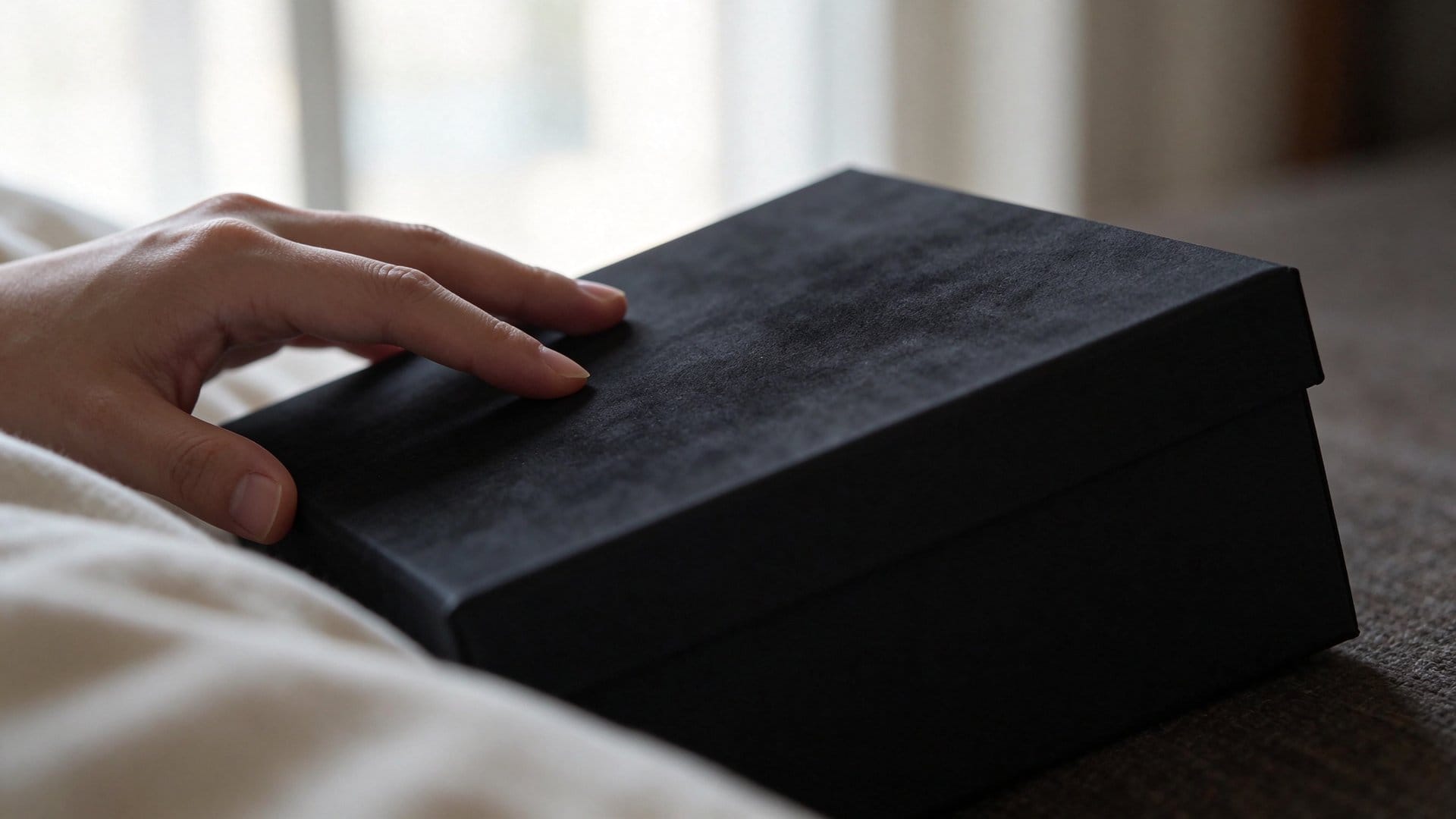
Soft touch lamination: the finish you feel before you see.
What Soft Touch Lamination Actually Is
Soft touch lamination — also sold as “velvet lamination” or “soft-touch film” — is a BOPP film with a fine matte coating applied on the surface side. It’s bonded to the printed sheet under heat and pressure, the same way standard matte or gloss film is applied.
The difference is the top coating. Instead of a smooth matte surface that scatters light evenly, the soft-touch coating has a micro-texture that:
- Absorbs almost all incident light, so colors look deeper and less reflective
- Creates slight friction against skin, which the brain reads as fabric or suede
- Hides fine surface scratches better than gloss, because there’s no specular highlight to break
It’s still a plastic film, not a paper coating. That matters for both durability and recyclability, which we’ll get to.
Why It Feels Expensive
Three things happen at once when someone touches a soft-touch box.
First, the light disappears. Gloss finishes create a bright reflection that tells your eye “this is plastic film.” Soft touch kills that highlight, so the surface reads as a material rather than a laminate.
Second, the fingers get resistance. Human skin is extremely sensitive to friction. A velvety surface produces a slight drag that smooth film doesn’t — the same cue you get from suede, felt, or uncoated paper.
Third, the color shifts. Soft touch deepens and slightly desaturates printed color, especially dark blues, greens, and blacks. On a matte black box, the result is nearly absolute — which is why the finish is so common on premium fragrance and jewelry packaging.
None of these cues survive a product photo. That’s the trade-off: soft touch wins in hand and in video close-ups, not in a flat e-commerce still.
What It Costs
Soft touch lamination costs more than standard matte film, and the gap is larger than most first-time buyers expect. Three components drive the price:
Film cost. The soft-touch film itself is a specialty material, priced above commodity matte BOPP. Expect a noticeable per-square-meter premium.
Lamination speed. Soft-touch film runs slower through the laminator than standard film, because the coating is sensitive to temperature and pressure. Slower line speed means higher conversion cost per sheet.
Waste and setup. Specialty film has tighter process windows, so setup waste is higher, particularly on short runs.
In practice, on a mid-volume folding carton order, soft touch typically adds a modest amount per box compared with uncoated board — but the increment is several times the cost of plain matte lamination. On a 1,000-piece order the total uplift is small in absolute terms; on a 30,000-piece order it becomes a real line item you should negotiate.
Ask for it as a separate line in the quote. Suppliers who bundle “matte lamination” and “soft touch” into one number are usually quoting standard film and hoping you won’t notice the difference in hand.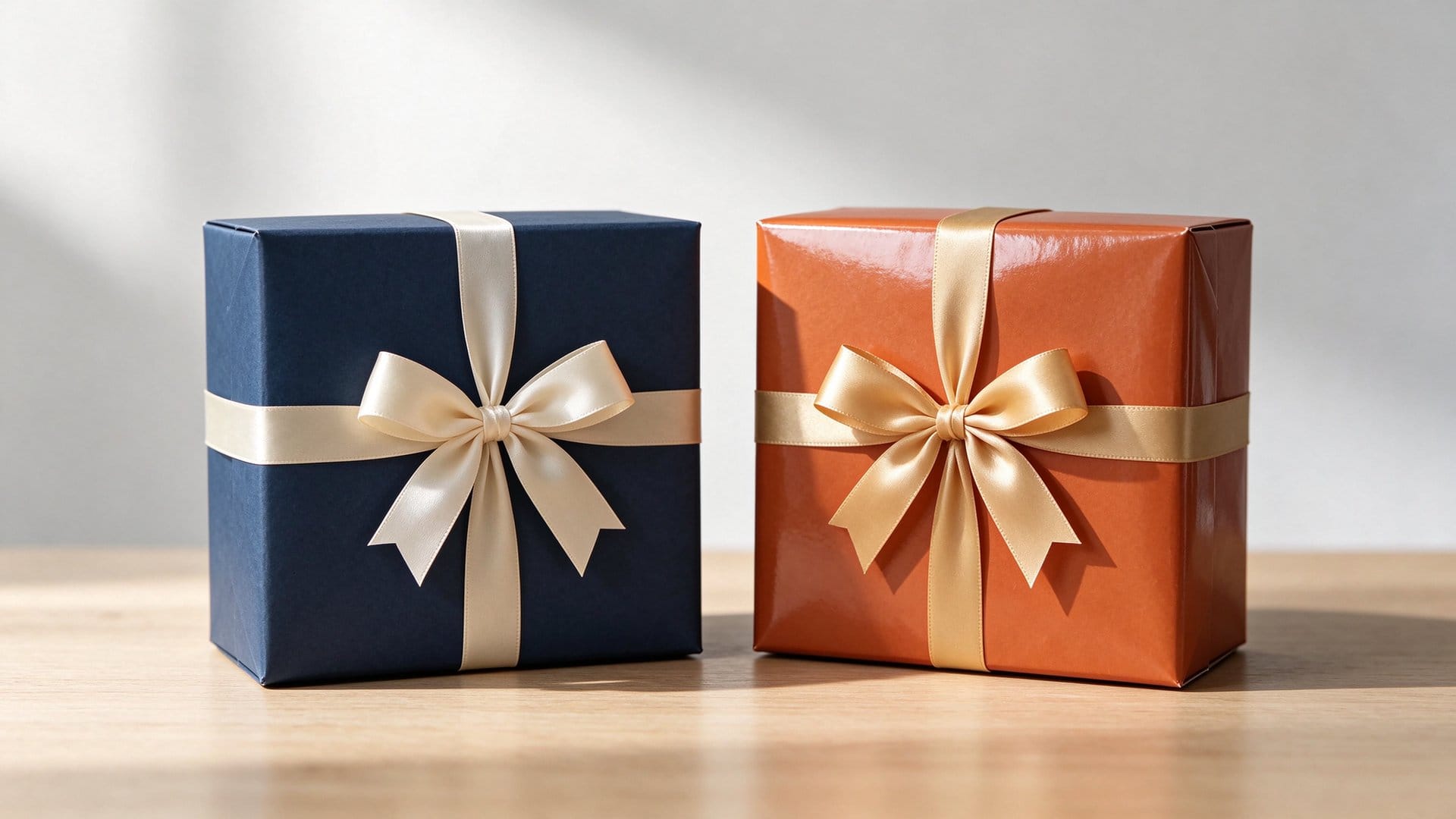
Same print, different film: the glossy box reflects a highlight; the soft-touch box swallows it.
When Soft Touch Is Worth It
Soft touch earns its premium in specific situations. It’s a waste of money in others.
The pattern is simple: soft touch pays off when someone will hold the box before they judge the product. If the box is opened once and thrown away, the finish is invisible money.
Soft Touch vs Other Finishes
Buyers often confuse soft touch with plain matte lamination. They are different products with different costs.
A useful rule: if you want the box to feel like paper, use varnish or uncoated board. If you want it to feel like fabric, use soft touch. If you want it to look shiny on a shelf, use gloss.
Design Considerations Before You Commit
Soft touch changes how artwork reads. Four adjustments prevent surprises.
1. Expect colors to deepen. Soft touch absorbs light, so the printed result looks darker and less saturated than the proof. Approve a laminated sample, never a digital proof. Navy can drift toward black; warm reds can turn brick.
2. Avoid large solid black areas unless you accept fingerprints. Dark soft-touch surfaces show every oily touch. If the design is mostly black, plan for spot UV or a textured pattern to break up the surface, or accept that retail handling will show.
3. Foil and embossing work beautifully — with sequencing care. Soft touch under gold foil is one of the strongest luxury combinations: the matte ground makes the metallic mark jump. Embossing, however, gets flattened by film applied on top, so the emboss must run before lamination, or the embossed panel must be left unlaminated.
4. Spot UV on soft touch is highly visible. Because the base absorbs light, a gloss UV spot creates a strong contrast. This is the cheapest way to add a second “moment” to a soft-touch box without another process.
Production and Lead Time
Soft touch adds a step to the schedule, not a week.
Lamination normally adds one to two working days to a folding carton run, plus drying time if the sheet goes back through printing for a second pass. On rigid boxes, the wrap paper is laminated before it’s mounted, so the timing depends on the wrapping schedule rather than the box assembly.
Two production details worth confirming:
- Film direction and tension. Soft-touch film can show tension lines if the laminator runs too hot or too fast. Ask the factory how they control it on your board weight.
- Board choice. Very thin board (below 300 gsm) can curl after lamination on both sides. If your structure is lightweight, either increase board weight or laminate one side only.
Ask for the lamination step in the production schedule. If a supplier says “it doesn’t affect lead time,” they’re either running it in-house with slack capacity or not being precise.
Rigid Boxes vs Folding Cartons: Same Film, Different Process
Soft touch lamination behaves differently depending on the box structure, and the cost gap between the two is large.
On a folding carton, the film goes directly onto the printed die-cut sheet. The laminator runs the flat sheet, then the sheet goes to cutting and gluing. This is the cheapest way to get soft touch, because the process is continuous and the sheet is flat.
On a rigid box, the film goes onto the printed wrap paper, not the box itself. The laminated wrap is then mounted over greyboard or chipboard, folded around corners, and glued inside. The extra step — mounting — means more labor, more waste on corner folds, and a higher rejection rate around the edges.
Practical consequences:
- Rigid boxes carry a higher soft-touch cost uplift than folding cartons, often noticeably so on small lids
- Corner and edge areas are where film lifting shows first — check the sample at the corners, not the center
- A rigid box lid wrapped in soft touch with an unlaminated base is a common cost-control tactic that still delivers the hand-feel where it matters
If your budget only allows soft touch in one place, put it on the lid or the front panel. That’s the surface the customer touches first.
Three Buyer Scenarios That Show When It Pays
Abstract advice is hard to apply. Here are three configurations that map to common product categories.
Scenario 1: Fragrance launch, 5,000 units. Rigid box, soft-touch laminated wrap, gold foil logo after lamination, unlaminated inner tray. The soft touch carries the “quiet luxury” signal in hand; the foil provides the shelf sparkle in photos. This is the highest-value combination per dollar and the one most fragrance brands land on.
Scenario 2: Skincare DTC, 3,000 units monthly. Folding carton with soft touch outside, plain uncoated inner, no foil. The goal is the unboxing video: the customer films the box before opening it, and the matte surface reads well on phone cameras because it doesn’t blow out highlights. Cost per unit stays low because there’s no foil or emboss step.
Scenario 3: Corporate gift set, 500 units. Rigid box with soft touch on the lid, embossed logo under the film (emboss first), and a matte paper sleeve. At this volume, the setup cost dominates, so adding more processes hurts more than the film itself. Keep it to one premium cue: the velvet lid.
Each scenario shares a logic: soft touch is placed where the customer’s hand goes first, and the expensive extras are cut where the camera can’t see them.
How to Test It Before a Full Run
Soft touch failures are almost always visible in a sample. Test four things before approving mass production.
1. Hand feel, blind test. Have three people touch the laminated sample without seeing it and describe the surface. If they say “smooth” instead of “velvety,” the film isn’t soft touch or the coating has been dulled by heat.
2. Color check under two light sources. Compare the laminated sample to the approved proof under daylight and under warm shop lighting. Soft touch shifts color differently depending on the light; approve under the light your customer will actually see.
3. Fingerprint test. Rub the surface with a clean thumb, then look at it from an angle. On dark solids you’ll see exactly what a shopper will see after handling it in a store.
4. Adhesion and edge test. Fold a corner and press; check whether the film lifts at the fold. Do a light tape-pull test on an edge. Edge lifting is the most common field failure and it starts at corners.
Ask the factory for the laminated sample on the actual board you’re ordering, not on a generic test sheet. Film adhesion depends on the board coating, and a different stock can behave differently.
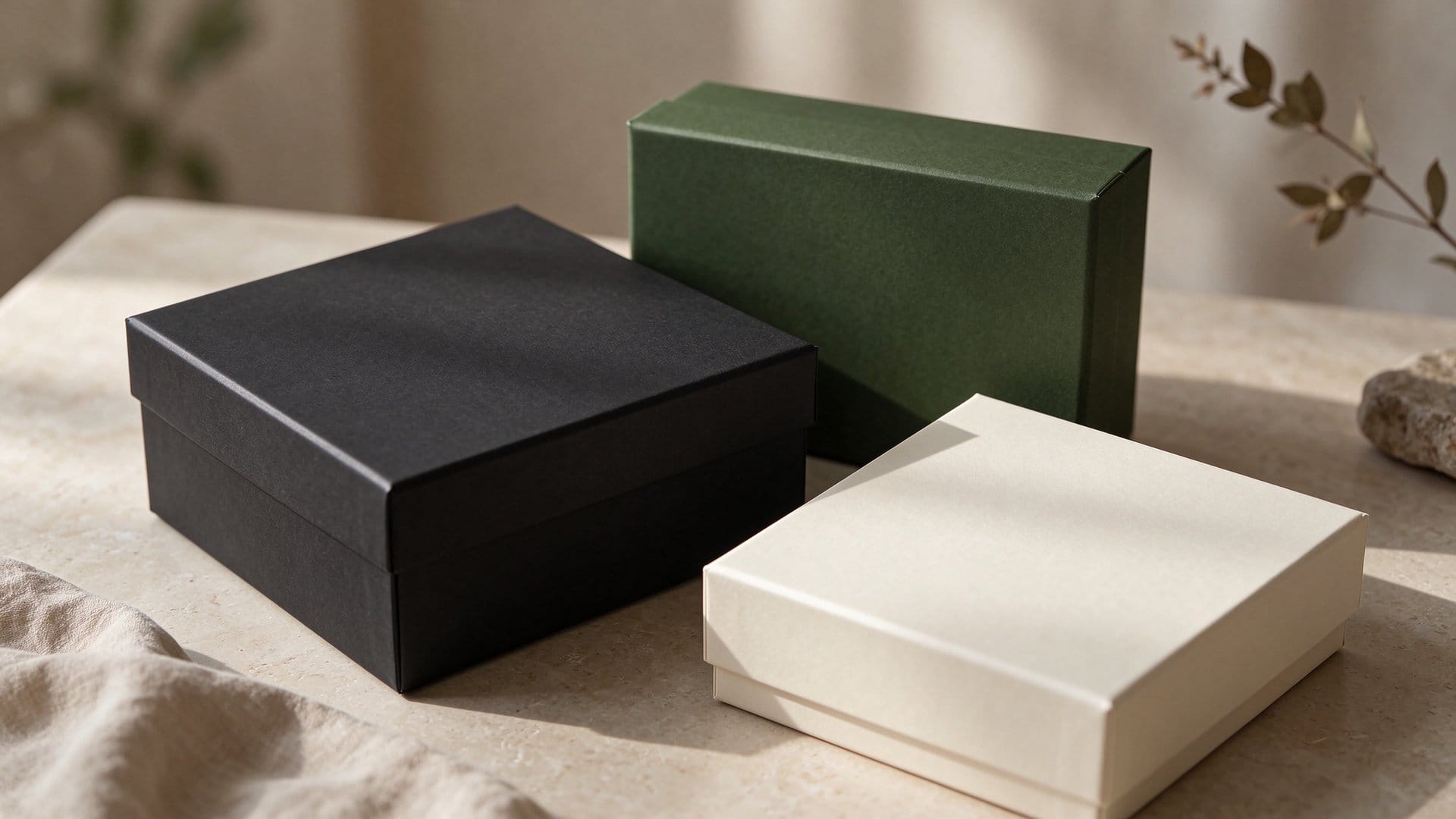 Same structure, three soft-touch colors: the finish reads as material, not film.
Sustainability and Recyclability
This is the part that surprises brands who order soft touch for an “eco” line.
Soft touch is a plastic film bonded to paper. In fiber recycling, the film is a contaminant: many mills reject or downgrade film-laminated board, and some European markets now require packaging to be mono-material or easily separable.
What you can do:
- Pair soft touch with FSC-certified board so the fiber side of the story is clean
- Use it on the outer box only, and keep the inner structure film-free
- Consider matte varnish or uncoated textured board as a “soft touch look” alternative when recyclability is a hard requirement
- Ask the factory whether their film is a paper-based soft-touch alternative, which some mills now offer
If your brand markets itself on recyclability, soft touch is a claim you need to test against your market’s rules before printing 30,000 boxes.
Common Mistakes
Mistake 1: Approving a digital proof. Soft touch changes color. Only a laminated physical sample is meaningful.
Mistake 2: Laminating over embossing. The film bridges the raised form and flattens it. Sequence the emboss first, or leave the panel unlaminated.
Mistake 3: Using soft touch on a box that will get wet or greasy. Films can lift at edges under moisture and oil. For food-adjacent packaging, choose a barrier coating instead.
Mistake 4: Assuming all “matte” is soft touch. Standard matte film is smooth and dry. If the quote doesn’t specify soft-touch film by name, you’re probably buying ordinary matte.
Mistake 5: Forgetting the fingerprint reality on dark solids. A black soft-touch box looks incredible in a photo shoot and shows every thumbprint in a store.
Mistake 6: Skipping the machine trial on new board. Film adhesion varies with board coating. A small trial run prevents a full-batch failure.
How to Specify It Correctly
When you send an RFQ, be explicit. A useful specification looks like this:
Finish: soft touch lamination, full coverage on printed wrap
Film: matte soft-touch BOPP, [brand or equivalent]
Board: [SBS 350 gsm / FBB 300 gsm]
Embossing: yes — must be applied BEFORE lamination
Foil: gold foil on logo — applied AFTER lamination
Sample: laminated physical proof required before mass production
Recyclability: [required / not required]
The two lines that matter most are the process order (emboss before, foil after) and the physical sample requirement. Most soft-touch failures trace back to one of those two.
FAQ
Is soft touch lamination the same as matte lamination? No. Both are matte, but soft touch has a velvety coating that standard matte film lacks. The cost difference is significant, and the hand feel is unmistakable.
Does soft touch lamination make colors look darker? Yes. It absorbs light, so printed colors appear deeper and slightly less saturated. Always approve a laminated sample.
Can I print on top of soft touch lamination? Screen printing and some digital processes can print on film, but adhesion is unreliable. For logos and text, use foil, embossing, or spot UV instead of overprinting.
Will soft touch lamination scratch? It hides fine scratches better than gloss because there’s no highlight to catch them, but deep gouges still show. It’s more durable in hand than in rough transit.
Is soft touch lamination recyclable? The paper can be recycled only where the mill accepts film-laminated board. In strict markets, treat it as non-recyclable unless your supplier offers a paper-based alternative.
How much more does soft touch cost than matte? Typically several times the cost of standard matte film per unit, plus higher setup waste on short runs. Ask for it as a separate quote line so the comparison is honest.
Can soft touch be applied to only part of the box? Not with standard equipment. Lamination runs full-sheet or full-wrap. If you want a tactile contrast, achieve it with spot UV, an unlaminated panel inside the box, or a different finish on a sleeve rather than on the same sheet.
Does soft touch lamination affect printing inside the box? No, as long as the inner surface stays unlaminated. If the sheet is laminated on both sides, the inside becomes non-printable and non-recyclable, and the box can curl. Keep lamination on the outside only unless you have a specific barrier requirement.
Get a Quote
Send us your artwork, box spec, and whether recyclability is a hard requirement — we’ll quote soft touch lamination as its own line, with the emboss and foil sequence confirmed. Guangdong Meiyin Digital Technology has produced custom paper packaging since 2005.