
A Complete Material Guide Paper for Box
It all begins with the paper. When we create custom boxes, the first step is to select the proper material. The choice of material directly impacts the durability, cost, and sustainability of the product, as well as the customer’s opinion of the product.
In this post, we’ll walk you through the most popular paper stocks used in packaging today and explain the types of paper the factory uses to produce the packaging boxes.
What Is Paper for Box?
Paper for box usually refers to paperboard (thicker than standard paper) and corrugated fiberboard (the layered material used in shipping boxes). These materials are meant to be stiff, foldable, printable and protective. Box paper is designed to hold shape, resist tearing and survive shipping and handling unlike office paper.
9 Types of Paper for Packaging Boxes
Packaging boxes adopt a wide range of paper substrates according to product positioning, printing requirements, structural strength and decorative effects. The mainstream paper materials for box making are categorized as follows:
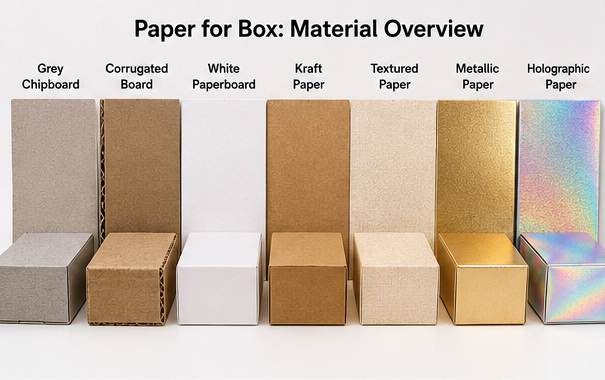
1.Grey Chipboard & Duplex Board
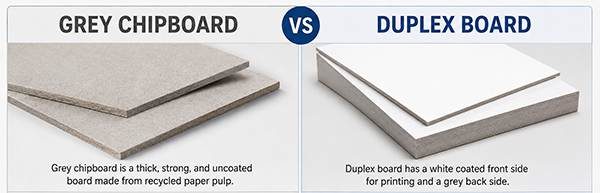
When your packaging needs a rigid, non-bending, and solid structure, chipboard is the industry standard.
Grey Chipboard: Made entirely from recycled paper fibers, this is a thick, dense material. It is the core material used to make “rigid boxes”—think of the iconic, sturdy iPhone box or high-end jewelry boxes. Because it looks plain grey, it is almost always wrapped with a premium printed paper liner on the outside.
Duplex Board with Grey Back: This board features two layers—a smooth, bleached white surface on one side (perfect for high-quality printing) and a classic grey recycled back on the inside.
2.Corrugated Board
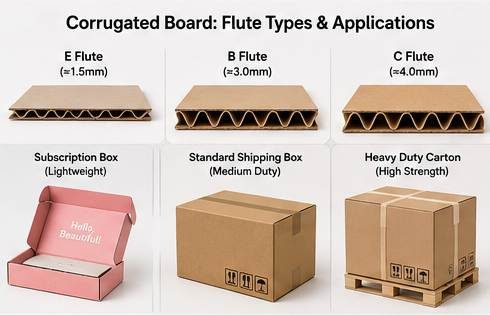
Corrugated board is the undisputed king of e-commerce shipping. It is made by sandwiching a wavy, fluted paper layer between two flat linerboards. This unique structure provides an air cushion that offers excellent shock absorption, structural stacking strength and puncture resistance.
It comes in different thicknesses called flutes. For something elegant for a subscription box, E-flute is right. But if you’re shipping heavier items and need more durability, B or C-flute is the way to go.
3. White Paperboard, Coated Paper & Kraft Paper
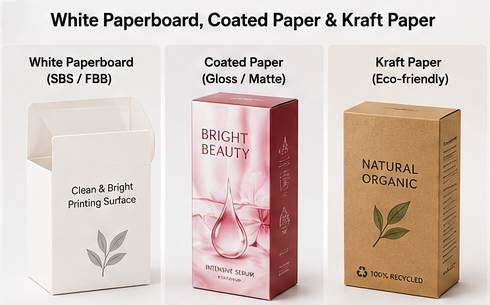
These are the most versatile materials for everyday folding cartons—the lightweight boxes you see lining retail shelves.
White Paperboard (SBS / FBB) Solid Bleached Sulfate (SBS) or Folding Boxboard (FBB) are high-grade, pure white paperboards. They give you a clean, blank canvas.If your brand relies on sharp graphics, precise Pantone color matching, this is your ticket.
Coated Paper (Art Paper): It is highly absorbent of ink and has an ultra-smooth surface, either glossy or matte. It is bright white and opaque, which means that images printed on the front do not bleed through to the back. Coated paper is the preferred choice for printing vibrant, high-definition images.
Kraft Paper: Eco-friendly branding champion, 100% recyclable and biodegradable. Kraft paper is naturally brown and unbleached, with long, strong fibers that resist tearing. It is absorbent, since its base color is not pure white, printed colors often appear less vibrant. But it creates an immediate organic, rustic, and sustainable impression.
4. Special Decorative Paper (Textured, Metallic & Holographic Specialty Paper)
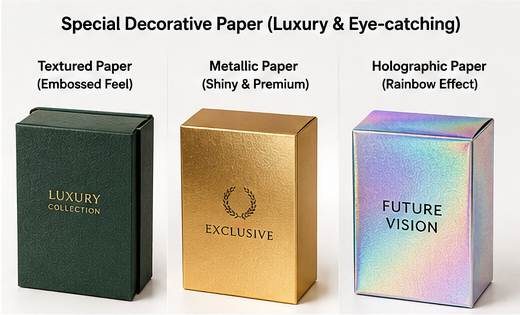
If you want your customers to feel a sense of luxury before they even open the box, specialty papers are used as outer wraps for rigid boxes. They rely on texture and light manipulation to create a memorable sensory experience.
Textured Paper: It brings a whole new dimension to packaging. Instead of a smooth finish, it features beautiful embossed patterns like linen, leather, woodgrain, or canvas. You don’t need fancy printing or complicated designs to make it look premium. The texture itself becomes the star of the show. The moment someone picks up the box, they can feel the quality.
Metallic Specialty Paper: Infused with metallic pigments or laminated with a micro-thin foil layer, this paper reflects light with a beautiful gold, silver sheen and elevates a product into the “luxury gift” category. It adds a three-dimensional depth to your design, when semi-transparent ink is applied over the metallic base, it creates a deep, metallic-paint finish.
Holographic Specialty Paper The surface of holographic paper is covered with a complex microscopic grating structure that can disperse light into rainbow colors. It shows rainbow gradients when viewed from different angles. It’s super modern and eye-catching.
Matching Box Types with the Right Paper Materials
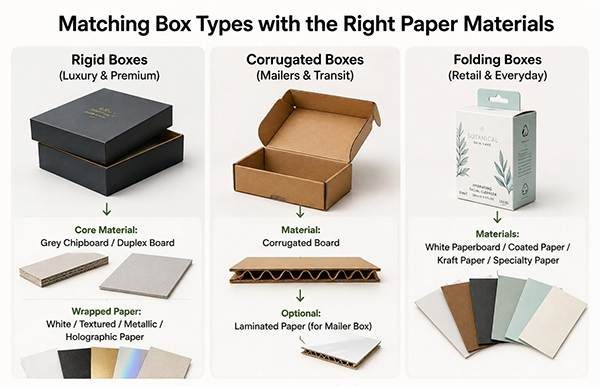
Different box structures serve different purposes—some are built for heavy-duty transit, while others are designed for retail display or luxury appeal. Here is a breakdown of the three most popular box types and the specific papers used to create them:
Rigid Boxes
Rigid boxes require solid, stiff base boards for stable box shaping. Grey chipboard and duplex chipboard act as the core base material.For outer surface decoration, manufacturers select lighter-weight white paperboard, coated paper, or premium specialty papers including textured paper, metallic specialty paper and holographic specialty paper to deliver delicate touch, glossy printing or eye-catching luxury visual effects. The wrapping paper weight typically ranges from 120gsm to 157gsm.
Shipping Cartons/Mailer box
Corrugated board is the standard material for shipping cartons and mailer boxes. Its layered structure provides excellent compression resistance and shock absorption. For heavy-duty shipping cartons, we typically print basic info directly onto the surface with no extra laminated layer. Mailer boxes, being smaller, often use a 300gsm laminated paper on either the exterior or interior to achieve high-quality graphics and branding.
Folding Boxes
Folding boxes prioritize printability and moderate hardness for easy die-cutting and folding.White paperboard and coated paper are the most mainstream options, presenting clear, vibrant printed patterns for daily goods, food and cosmetics. Kraft paper is also applied for simple, eco-style folding packaging. For high-end customized folding boxes, metallic and holographic specialty papers are used to upgrade product grade.The paper weight typically ranges from 250gsm to 450gsm. Some folding boxes are made of corrugated cardboard.
Paper Packaging Box Material Comparison
Many buyers use the terms interchangeably, but there is a difference.
Material | Typical Thickness | Primary Use |
Paper | Less than 0.3 mm | Printing, wrapping, labels |
Paperboard | More than 0.3 mm | Folding cartons, packaging boxes |
Greyboard | 1 mm – 4 mm | Rigid boxes |
Corrugated Board | Multiple layers | Shipping cartons |
Most packaging boxes are actually made from paperboard rather than ordinary paper.
Why the Right Paper Matters
Choosing the correct paper for your boxes isn’t just about cost — it impacts brand perception, product protection, and environmental footprint.
1. Protection & Durability
The protective performance and durability of a box depend largely on the paper’s grammage (weight per square meter); generally, thicker paper with higher grammage offers superior protection and durability. The lightest is the folding cartons (200-450 gsm) and then the mailing boxes (300-600 gsm). Rigid boxes are the heavy duty tier with a combined grammage of 800-1500 gsm.
2. Printability & Branding
Box paper today can be printed on in high resolution, embossed, foiled, or finished with a matte or gloss. When a customer sees your packaging, it becomes a powerful marketing tool, especially special paper.
3. Cost efficiencies
Optimising the balance between thickness and structural integrity means less material is required. This efficiency has a direct impact on lower freight and manufacturing overheads without reducing the protection offered by your product.While 1000gsm is the usual thickness for premium construction, 800gsm still offers a good baseline for rigid packaging if a lighter structural profile is acceptable.
4. Sustainability
Today’s consumers expect eco-conscious packaging. Recyclable, biodegradable, and FSC-certified paper for boxes is now a competitive advantage rather than a nice-to-have.
How to Choose the Best Paper for Your Box
Selecting suitable paper materials for packaging boxes does not require complicated professional knowledge. The core step is to clarify your product positioning first, which directly determines your ideal box style, packaging grade and visual effect.
After confirming your product positioning and final box type, you only need to clearly communicate your requirements to packaging suppliers. Experienced packaging manufacturers know all these papers inside and out — their strengths, limitations, and ideal uses.
They’ll listen to your needs (budget, printing requirements, desired texture, and target feel) and recommend the best options for you. Whether it’s grey chipboard for rigid boxes, corrugated board for shipping, coated paper for retail packaging, or any of the specialty papers like textured, metallic, or holographic, they can help you pick the perfect match that looks great and performs exactly as needed.
Conclusion
Paper for box is more than a packaging material, it’s a fundamental part of your product’s journey.If you are looking for custom paper boxes, rigid boxes, gift boxes, or packaging solutions that are suited to your products, working with an experienced packaging manufacturer like MEIYIN can help ensure the best material choice and packaging performance.

With more than 10 years of experience in OEM/ODM/Private Label Paper Packaging, I'd love to share with you the valuable knowledge related to paper box products from a reliable Chinese supplier's perspective.