
Best 4 Insert Options for Custom Two-Piece Boxes
Introduction
In the case of personalized two piece boxes, the outer box is usually given the greatest consideration. However, the insert (inner tray) also plays a significant role in protecting products, enhancing presentation, and overall user experience.
The identical two-piece box can be totally different depending on the kind of insert.Inserts influence the quality of product security, the appearance of the product once the box is opened, and its shipping performance. Selection of the correct insert is thus an important or major step in effective custom packaging.
This manual provides the best 4 choices of inserts to use in custom two-piece boxes and which each one would be best. Next, we’ll first give an overview of common underlay types, and then delve into a comparison of the Top 4 options.
Summary of Frequent Types of Inserts.
Inserts for two piece box are generally made to fit into the base and keep products in place. Foam, paper inserts, fabrics lining, and moulded components are the most widespread examples of insert materials.
Different types of inserts are used to achieve different things. They emphasize the protection, or cost efficiency, sustainability, or high-end look. From an awareness of these differences, brands and buyers can choose an insert that is compatible with the functional needs and with brand positioning.
Top 4 Insert Options
The following four types of inserts are sorted by usage popularity and applicable scenarios, from the most general to more specific needs, to help you quickly identify the right one.
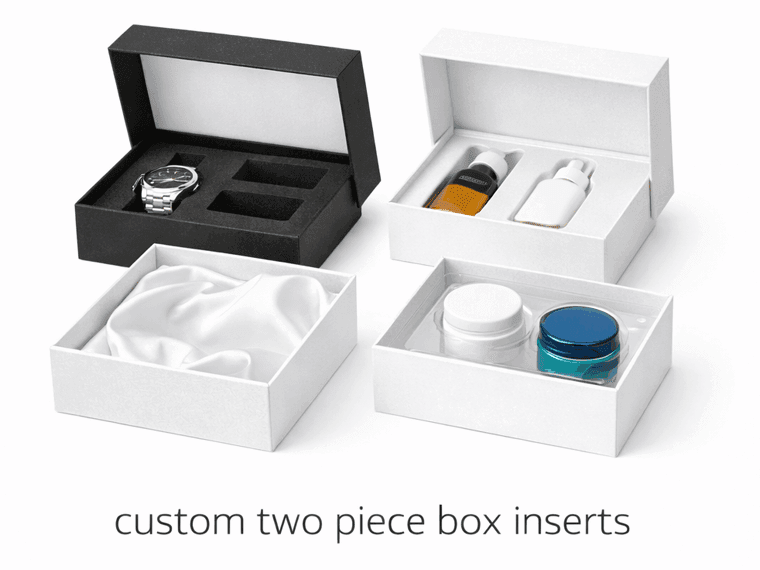
Foam insert
Foam inserts are often considered the best choice for custom two piece boxes, particularly when the protection of the products is a priority.Foams can be cut into the right shape to fit the shape of a specific items , thus ensuring it is well secured during the transportation process.
Three Types of Foam:
- PU Foam: Open-cell structure, soft, resilient, and low cost. Suitable for displaying luxury goods. Disadvantages: Not water-resistant, prone to yellowing over time. Density is typically 18–35 kg/m³.
- EVA Foam: Closed-cell, high-density options available 30–150 kg/m³, durable, and resistant to deformation. Suitable for electronics, tools, and long-term storage. Surface can be velvet-flocked.
- PE Foam: Lightweight and waterproof, but with lower resilience—best for basic filling rather than precise positioning.
| Material | Application | Relative Cost |
|---|---|---|
| PU Foam | Cosmetics, Luxury Gift Sets | Low |
| EVA Foam | Electronics, Tools, Jewelry | Medium–High |
| PE Foam | Filling, Cushioning | Low |
Best for:
- High-quality electronics or equipment
- Products needing strong protection
- Custom-cut support for irregularly shaped or delicate items
Summary:
Foam inserts are the most popular and cost-effective option.
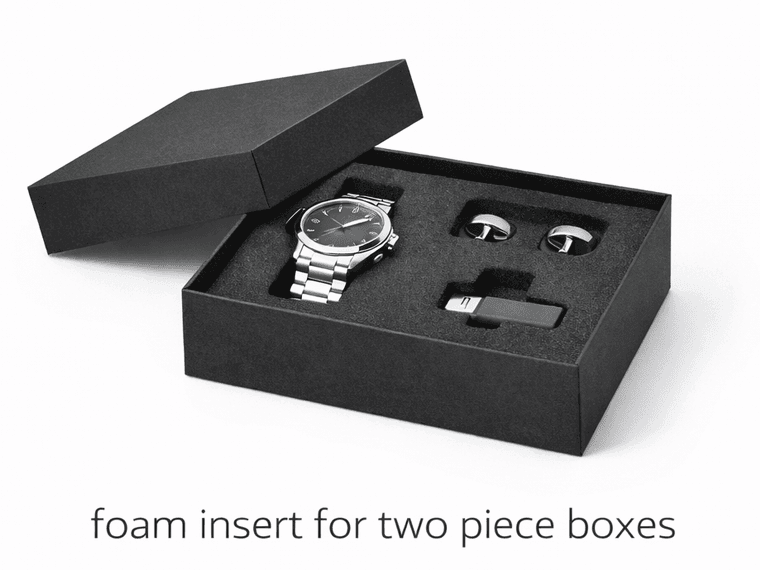
Molded Pulp & Cardboard Inserts
A cheaper and environmentally friendly alternative is paper inserts. They are normally crafted using cardboard, corrugated paper, or molded pulp, and they offer structural support to products.
Molded pulp is currently a star material for sustainable packaging. It can be 3D molded, provides some cushioning in drop tests, some densities outperform low-end foam, and is 100% recyclable/biodegradable.Strength decreases after absorbing moisture
Best for:
- Lightweight products
- Mid-to-high-end eco-friendly brands
- The green packaging initiatives
Summary:
Paper/Molded Pulp is a budget-friendly and environmentally friendly option.
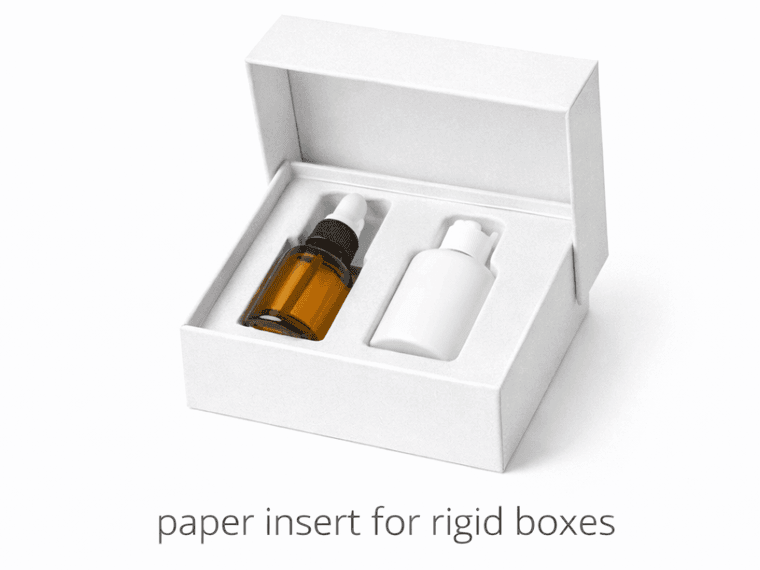
Silk or Fabric Lining Insert
Silk or cloth lining inserts are included mainly to increase the visual appeal and to provide an ultimate unboxing experience. These inserts are also typically structured with a foam or paper base and coated with fabric, like silk, velvet, or satin. Inserts made of fabric are typically found in the luxury jewelry, cosmetic and gift packaging. They are costly and have weak protective performance.
Best for:
- Luxury and high-end products
- Brand-focused presentation
Summary:
Fabric/Silk-Lined Inserts are the preferred choice for luxury displays.
Plastic or Blister Insert
Plastic or blister inserts are thermoformed to match the exact shape of the product, ensuring precise positioning inside the box.Once the tooling is finalized, every insert produced will have identical dimensions, making them ideal for standardized mass production.
They are often applied in situations where uniform presentation and strict positioning are needed. Their molds are expensive and design changes are difficult.
Best for:
- High-volume production
- Standardized products in shape.
Summary:
Plastic/Blister inserts are ideal for standardized products in large production runs. Although the initial tooling cost is higher, the per-unit cost becomes highly competitive at scale. Anti-static materials are available for electronic packaging applications.
Having learned about the various types of inserts, let’s now look at how to make a final choice based on your specific needs.
Selection of the Right Insert Option
The selection of the appropriate insert is based on a number of factors:
- The weight and fragility of the product.
- Shipping and handling terms.
- Brand positioning and experience of unboxing.
- Budget and order quantity
| Priority | First Choice | Second Choice | Avoid |
|---|---|---|---|
| Heavy/Fragile | EVA | PU Foam | Paperboard/Blister |
| Sustainable + Appearance | Molded Pulp | Paperboard | Foam |
| High-end | Silk + EVA | Silk + PU Foam | Plastic |
| Small Batch (<1000) | PU Foam/Paperboard | Molded Pulp | Blister |
| Large Batch | Blister | EVA | Silk/Fabric |
An example is that protection-based packaging should be made using foam or EVA inserts to provide protection, whereas luxury presentation should be made using fabric-lined inserts. Paper inserts provide a compromise between price and sustainability.
When collaborating with a well-established packaging maker, it is possible to realize the most appropriate insert design according to the actual usage rather than the design.Even if you choose the right type, you might still fail because of the following common misconceptions.
Common Mistakes When Choosing Inserts for Two-Piece Boxes
- Focusing solely on aesthetics while neglecting practical protection needs during transport. For example, choosing pure velvet lining ignores its high cost, tendency to shed fibers and attract dust, and the difficulty of applying it. Velvet linings are typically used for high-end jewelry packaging, in small-batch custom orders.
- The impact of minimum order quantity and mold costs was underestimated. For example, choosing blister packaging but only ordering 500 pieces resulted in an excessively high unit price. Blister packaging should only be chosen as an inner liner for electronic products that require insulation, and in quantities exceeding ten thousand.
- Choosing the wrong density or type of foam/EVA material. For example, using low-density PU foam to pack heavy electronic products can cause them to be crushed.
- Ignoring the match between brand positioning and material. For example, a mid-range brand is forcing a full velvet + EVA blend, resulting in unnecessary and drastically increased costs.
- Satisfactory in the sample stage, but tolerance/warpage issues are exposed during mass production. For example, pulp molding deforms in high-humidity environments.
By avoiding these pitfalls, your packaging solution can get closer to perfection.
Conclusion
Custom two-piece boxes require inserts, which play a crucial role in protecting, presenting, and delivering customer experience. The best option for an insert does not exist; it comes down to the insert that is most appropriate to your product, brand, and logistics needs.
Given the advantages and disadvantages of the various types of inserts, along with the professional advice of a trusted packing factory, it becomes possible to develop the best and most functional packaging strategy that appeals to the brand on a visual level.
FAQ:
Q 1: What is the most popular insert to use when using custom two piece boxes?
The most widely used ones are the foam inserts because of their flexibility, protection, and customization possibilities.
Q2: Do paper inserts offer strong protection to products?
Paper inserts work well for lightweight items; they do not provide good shock absorption as compared to foam or EVA inserts.
Q3: Can fabric-lined inserts be used without other materials?
No. Fabric lining is usually combined with foam to provide structure, positioning, and a premium look
Q4: Which insert is best for luxury packaging?
Luxury / high-end packaging is usually done in fabrics with foams or EVA.
Q5: How do I choose the right insert for my product?
Take into account the weight of the product, its fragility, the conditions during shipping, the positioning of the brand, and the budget. A visit to the manufacturer of packaging may assist in narrowing down the selection.

With more than 10 years of experience in OEM/ODM/Private Label Paper Packaging, I'd love to share with you the valuable knowledge related to paper box products from a reliable Chinese supplier's perspective.
Table of Contents
Own your OEM/ODM/Private label of paper packaging is so easy here.