
The Ultimate Guide To Mailer Box Size
Introduction
When it comes to packaging, one of the most common yet overlooked questions is deceptively simple: “What size mailer box should I use?”
The size you choose isn’t just a matter of aesthetics. It directly affects how well your products are protected during shipping, how much you’ll pay in freight charges, and even the overall unboxing experience your customers will remember. A box that’s too small risks damage, while an oversized box can inflate shipping costs and create a wasteful impression.
This ultimate guide will walk you through everything you need to know about mailer box size:
- The standard dimensions of mailer boxes most businesses rely on
- A step‑by‑step method to measure the right box size for your product
- When and why to consider custom packaging solutions
By the end, you’ll be equipped with the knowledge to choose mailer boxes that balance cost, protection, and brand presentation—helping you ship smarter and impress your customers. For deeper insights on the cost side, you can also explore our article on why mailer boxes are expensive.
Understanding Why Mailer Box Size Matters
Choosing the right mailer box isn’t just about “will my product fit.” Box size has a ripple effect across logistics, customer satisfaction, and even brand perception. Here are the key areas where size plays a crucial role:
Shipping Safety
A properly sized box prevents items from shifting during transit. Products packed in oversized boxes are vulnerable to breakage unless you add extra fillers, while undersized boxes may damage delicate edges. For fragile goods like cosmetics, glassware, or electronics, a snug custom rigid box ensures safety without wasting material.
Freight Charges
Most carriers use dimensional weight pricing, which means your box’s volume matters just as much as its weight. An unnecessarily large mailer box could double your shipping fee. To minimize costs, businesses often switch to custom corrugated mailer boxes that are optimized for both durability and efficient sizing.
Brand Perception & Customer Experience
When customers unbox a product, packaging speaks volumes. A sleek mailer that fits the product perfectly highlights attention to detail and professionalism. On the other hand, receiving a tiny item in a huge box with fillers can feel careless and wasteful—hurting brand trust. Enhancing presentation through magnetic gift boxes or well‑proportioned drawer packaging can elevate the unboxing experience.
Sustainability
Oversized packaging contributes to material waste and higher carbon emissions during shipping. Eco‑conscious shoppers often prefer brands that use sustainable materials like kraft paper boxes or slim, eco‑friendly structures. Choosing the right size means you reduce void fill, save material, and deliver an environmentally responsible package.
Problems with Wrong Sizing
- Too large: Higher shipping fees, wasteful materials, poor customer impression.
- Too small: Risk of breakage, compromised safety, negative user experience.
In short, the right size is a balance: protective, cost‑effective, eco‑friendly, and brand‑enhancing.
A Guide on Mailer Box Sizes and Dimensions
When selecting a mailer box, the first step is understanding how to measure it correctly. Ordering the wrong dimensions can lead to packaging waste, increased shipping fees, or worse—product damage.
Measuring Basics: Length × Width × Depth
- Length: the longest side of the box opening
- Width: the shorter side of the box opening
- Depth (or Height): measured from the opening down to the base
Dimensions are usually listed in this order: (L × W × D). For example, a mailer listed as 10″ × 8″ × 4″ means:
- 10 in = length
- 8 in = width
- 4 in = depth
Internal vs External Dimensions
- Internal dimensions describe the usable space inside the box—what your product actually fits into.
- External dimensions measure the outside footprint, which affects shipping calculations and storage.
Carriers often rely on external dimensions for dimensional weight shipping, while product fit requires you to look at internal dimensions. When ordering, always confirm which measurement system your supplier follows.
Mailer Size Examples by Product
| Product Category | Recommended Mailer Box Size (inches) | Metric (cm) |
| Apparel (T-shirts) | 12 × 9 × 2 | 30 × 23 × 5 |
| Cosmetics set | 8 × 6 × 3 | 20 × 15 × 8 |
| Books & documents | 10 × 8 × 2 | 25 × 20 × 5 |
| Small electronics | 14 × 10 × 4 | 36 × 25 × 10 |
📌 Pro Tip: Always add a buffer (0.25–0.5 in / 0.5–1.2 cm) around your product when measuring to allow room for protective inserts or wrap.
Standard Mailer Box Sizes
While every product requires careful measurement, most businesses rely on a few standard mailer box dimensions. Choosing from these popular size ranges often means better cost efficiency and faster availability.
Small Mailer Boxes
Typical sizes: 3 × 3 × 2 in (8 × 8 × 5 cm) or 12 × 12 × 12 in (30 × 30 × 30 cm).
- Ideal for gift cards, accessories, jewelry, small cosmetics, or documents.
- Great choice for reducing shipping costs when sending lightweight, compact items.
- Example product: Kraft paper boxes.
Medium Mailer Boxes
Typical size: 18 × 14 × 12 in (46 × 36 × 30 cm).
- Perfect for apparel, beauty kits, shoes, or small home appliances.
- Balances reasonable shipping charges with solid protection.
- Example product: Custom two‑piece boxes.
Large Mailer Boxes
Typical size: 24 × 18 × 24 in (61 × 46 × 61 cm) or larger.
- Designed for bulk shipping, subscription boxes, and heavier items.
- Excellent for consolidating multiple products into a single parcel.
- Example product: Custom corrugated mailer boxes.
Comparison Table of Standard Mailer Box Sizes
| Size Category | Common Imperial Sizes | Metric (cm) | Typical Uses | Pros | Cons |
| Small | 3×3×2 in / 12×12×12 in | 8×8×5 / 30×30×30 | Gift cards, jewelry, small cosmetics, docs | Low cost, easy to store, lightweight | Limited protection, not for fragile goods |
| Medium | 18×14×12 in | 46×36×30 | Apparel, skincare kits, shoes, small appliances | Versatile, balance between cost & protection | May require fillers for odd-shaped items |
| Large | 24×18×24 in+ | 61×46×61+ | Bulk shipments, subscription boxes, electronics | Fits larger orders, fewer shipments | Higher freight charges, storage space needed |
📌 Tip for cost savings: Selecting a medium size close to product dimensions often minimizes both packaging material waste and dimensional weight charges.
Step‑by‑Step Guide to Measuring Mailer Box Size
Selecting a mailer box based only on “what looks right” often leads to wasted money and damaged items. The key is to measure systematically.
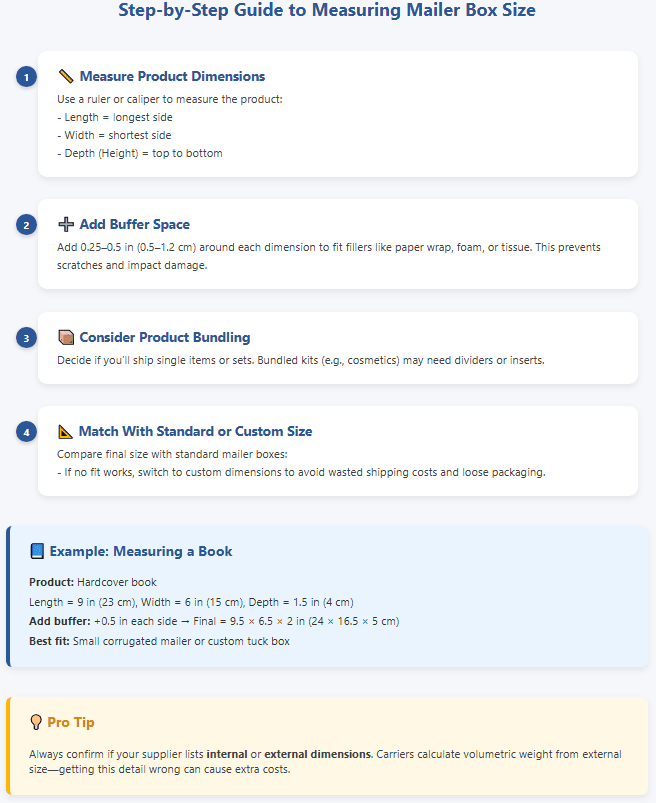
Step 1: Measure Product Dimensions
Use a ruler or caliper to measure the length, width, and height of the product.
- Length = longest side
- Width = shortest side
- Depth (Height) = top to bottom
Step 2: Add Buffer Space
Leave 0.25–0.5 in (0.5–1.2 cm) around each dimension to accommodate protective fillers like paper wrap, foam inserts, or custom tissue paper. This prevents scratches and impact damage.
Step 3: Consider Product Bundling
Will you ship a single item or multiple items together? For sets—like custom cosmetic kits—plan for dividers or inserts inside the box.
Step 4: Match With Standard or Custom Size
Compare your product + buffer measurements with standard mailer box sizes.
- If no fit works, move to custom dimensions so you don’t overpay for shipping or risk loose packaging.
Example: Measuring a Book
- Product: Hardcover book
- Length = 9 in (23 cm)
- Width = 6 in (15 cm)
- Depth = 1.5 in (4 cm)
- Add buffer: +0.5 in each side
- Final dimensions: 9.5 × 6.5 × 2 in (24 × 16.5 × 5 cm)
Best fit: A small corrugated mailer or custom tuck box.
Custom Mailer Packaging Size
While standard mailer boxes cover many shipping needs, there are plenty of scenarios where off‑the‑shelf sizes won’t fit. Awkwardly shaped products, premium branding requirements, or fragile items all benefit from custom sizing.
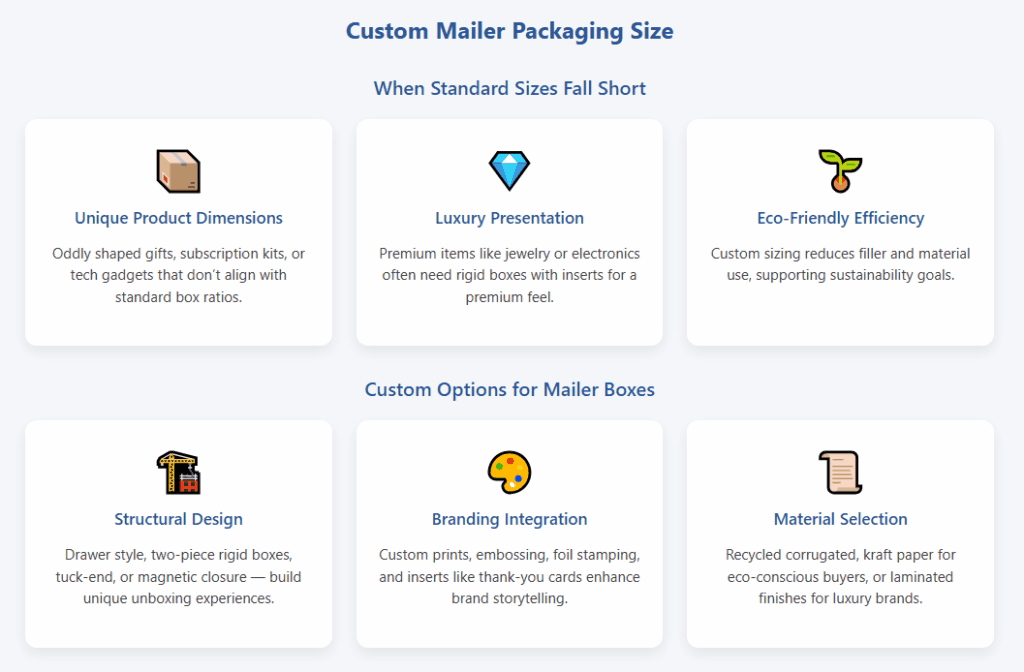
When Standard Sizes Fall Short
- Unique product dimensions: Oddly shaped gifts, subscription kits, or tech gadgets that don’t align with standard box ratios.
- Luxury presentation: Premium items like jewelry or electronics that require enhanced rigid packaging with inserts.
- Eco‑friendly efficiency: Custom sizing reduces filler and material use, aligning with principles of sustainable packaging.
Custom Options for Mailer Boxes
1.Branding integration
- Custom prints, embossing, and foil stamping help turn packaging into a marketing tool.
- Personal touches (like thank you cards or custom labels) reinforce brand loyalty.
2.Material selection
- Recycled corrugated mailers for bulk and durability
- Kraft packaging for eco‑conscious customers
- Laminated or coated finishes for luxury brands
Why Custom Dimensions Add Value
- Perfect fit reduces transit damage.
- Optimized volume minimizes dimensional weight charges.
- Memorable unboxing improves customer experience and retention.
In short, custom mailer sizes are not just about fitting the product—they’re about balancing protection, cost, and brand storytelling.
Strive for Uniqueness in Measuring & Designing
In today’s competitive market, packaging isn’t just a protective shell—it’s often the first physical touchpoint between your brand and the customer. Two elements make the biggest difference: precise sizing and unique design.
Accurate Measurements = Functional Excellence
- An accurately sized mailer shows attention to detail and reduces shipping waste.
- Products sit securely, reducing the need for excess fillers.
- Extra care with measurements avoids sizing mistakes that create negative impressions.
For instance, when brands invest in custom corrugated mailer boxes tailored to their exact inventory, they save money on freight while delivering sturdier, greener packaging.
Unique Design = Brand Differentiation
Beyond dimension accuracy, packaging design reflects brand values. Customers often share striking packaging on social media, turning your box into free marketing. Consider:
- Structural creativity: Magnetic gift boxes or drawer‑style boxes amplify perceived value.
- Visual storytelling: Custom graphics, colors, and typography transform ordinary packaging into a memorable unboxing ritual.
- Eco‑friendly finishes: Using recycled inks or minimalist kraft paper finishes signals commitment to sustainability.
Why It Matters
Research shows that packaging influences purchase intent and brand loyalty. A box that’s both perfectly sized and visually unique reinforces trust while leaving a lasting impression.
 Pro Tip: Strive for a balance—precise dimensions for shipping efficiency, plus standout design for customer impact. Together, they elevate packaging from a necessity into a brand asset.
Cost Implications of Mailer Box Size
Size doesn’t just affect how well a product fits—it directly alters your bottom line. Many businesses overlook how packaging size quietly drives both logistics costs and customer perception.
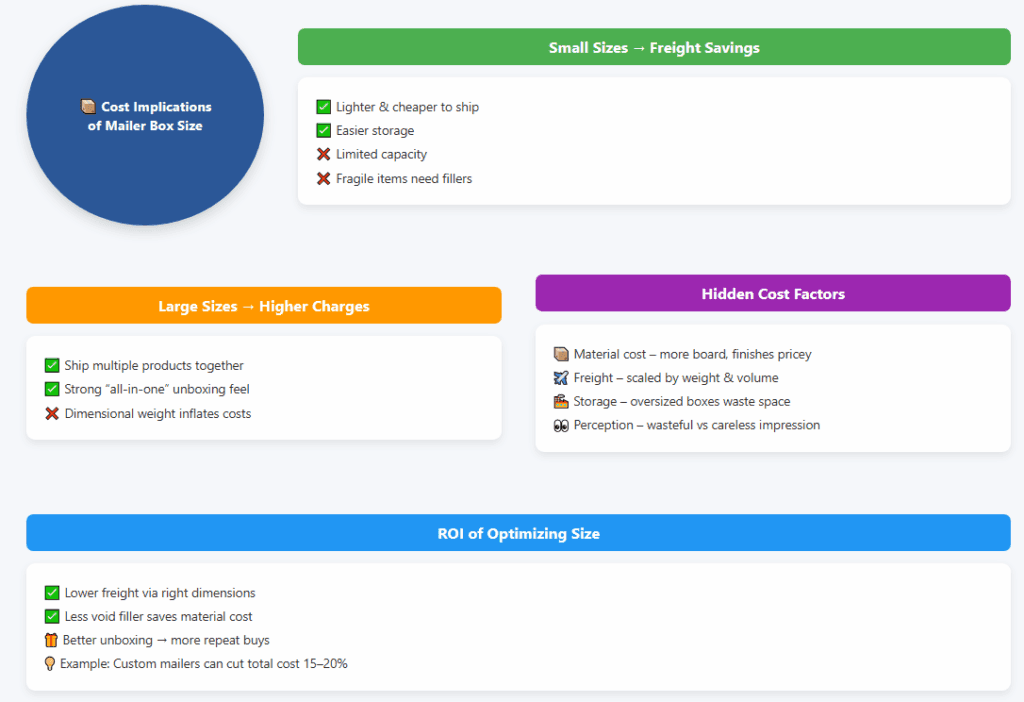
Small Sizes → Freight Savings but Limited Capacity
- Pros: Lighter, cheaper to ship, and easier to store. Small boxes like custom tuck boxes are perfect for compact items such as cosmetics or accessories.
- Cons: Can’t accommodate bulk orders, and fragile items may need added protective fillers.
Large Sizes → Consolidation but Higher Charges
- Pros: Useful for shipping multiple products in one go. A large corrugated mailer box reduces handling and delivers a single “all‑in‑one” unboxing experience.
- Cons: Carriers calculate delivery rates based on dimensional weight, meaning larger boxes can cost considerably more even if light in weight.
Hidden Cost Factors to Balance
- Material cost – Bigger boxes use more paperboard or corrugated material. Premium finishes like foil or lamination increase expenses further.
- Freight charges – Shipping companies scale pricing on both weight and box volume.
- Storage & handling – Oversized boxes take more warehouse space and increase fulfillment complexity.
- Customer perception – Oversized packaging looks wasteful; too small feels careless. Choosing the right size is itself a brand value signal.
ROI of Optimizing Box Size
Investing in custom sizes often delivers strong returns over time:
- Lower shipping costs from minimized dimensional weight.
- Reduced need for void fillers (bubble wrap, foam), saving materials.
- Higher customer satisfaction, leading to repeat purchases.
For example, shifting from generic oversized cartons to bespoke corrugated mailers can cut packaging and freight costs by 15–20%, while also reinforcing your sustainability goals.
Key takeaway: The right size isn’t just about protecting your product—it’s about optimizing your overall ROI through smarter freight, material efficiency, and better customer experience.Future Trends in Mailer Box Dimensions
As e‑commerce and sustainability standards evolve, the future of mailer box sizing is shifting away from “one‑size‑fits‑all” toward smarter, eco‑driven, and technology‑backed solutions.
Lightweight & Eco‑Compliant Dimensions
Brands are moving toward slimmer, lighter mailers that meet both regulatory and consumer expectations on carbon reduction. Packaging suppliers emphasize biodegradable coatings, recycled kraft packaging, and minimalist box structures. This aligns with broader efforts in sustainable packaging.
Small‑Batch, On‑Demand Custom Sizes
Print‑on‑demand and small‑batch production models enable businesses to order custom box dimensions in low minimum order quantities (MOQs). Instead of holding excess inventory, brands can request just‑in‑time mailers for product launches or seasonal drops—whether that’s drawer‑style boxes for limited editions or magnetic gift boxes for premium collaborations.
Smarter Sizing with Logistics Integration
Emerging technologies integrate packaging directly into logistics systems.
- AI‑driven dimensioning tools calculate the smallest box required for each shipment.
- Fulfillment centers adopt automated corrugators that cut custom dimensions on demand.
- Carriers experimenting with real‑time volumetric pricing will incentivize merchants to fine‑tune box sizes in sync with distribution software.
What It Means for Businesses
The shift highlights a key competitive advantage: companies that embrace right‑sized, eco‑smart mailers will lower costs, reduce waste, and strengthen consumer trust. Future packaging won’t just be about protection—it will be about intelligent, sustainable fit.
Conclusion
Choosing the right mailer box size is more than a logistics decision—it’s a smart business strategy. The right dimensions help you:
- Reduce material and freight costs
- Protect products during transit
- Enhance unboxing and customer satisfaction
- Strengthen your commitment to sustainability
At the same time, size choices shape brand perception. A carefully measured, well‑designed mailer signals professionalism and care—qualities that customers remember long after delivery.
To achieve that balance of efficiency and branding impact, it’s best to work with experienced packaging partners. At Meiyin Packaging, we specialize in custom corrugated boxes, luxury rigid boxes, and a wide range of eco‑friendly solutions tailored to your needs.
Next step:- Explore our full product catalog for inspiration
- Or contact us today for a custom quote designed around your product, brand, and shipping needs
With the right box size, you don’t just ship products—you ship a better brand experience.
FAQ Section
1. What is the standard size of a mailer box?
There isn’t a single “standard” size. Common options range from 3×3×2 in for jewelry to 24×18×24 in for bulk shipping. For reference, many e‑commerce retailers rely on 12×9×2 in corrugated mailer boxes for apparel and accessories.
2. How do I measure a box for shipping?
Measure Length × Width × Depth (Height) in that order, starting with the longest side. Don’t forget to add 0.25–0.5 in buffer space to protect items. Always confirm whether your supplier provides internal or external box dimensions.
3. Are there universal sizes for e‑commerce mailers?
No universal standard exists since every product is different. However, sizes like 10×8×2 in and 14×10×4 in are frequently used for books, beauty products, and small electronics. Many retailers opt for custom tuck boxes to standardize their shipments.
4. Is custom sizing always more expensive?
Not necessarily. While custom sizing may have a higher unit cost, it often saves money in the long term by reducing dimensional weight charges and packaging waste. Many businesses see strong ROI when shifting to made‑to‑fit mailers.
5. Which mailer box size is best for clothing, books, or cosmetics?
- Clothing: Medium mailers like 18×14×12 in are commonly used for apparel.
- Books: Small mailers around 10×8×2 in or custom tuck boxes work well.
- Cosmetics: Compact boxes like 8×6×3 in, often with inserts, ensure protection and premium presentation (e.g., drawer style boxes).

Hi, I'm WiWi Deng, hope you like this blog post
With more than 10 years of experience in OEM/ODM/Private Label Paper Packaging, I'd love to share with you the valuable knowledge related to paper box products from a reliable Chinese supplier's perspective.
Contents
Own your OEM/ODM/Private label of paper packaging is so easy here.